
Some of the finest street food in the world can be found across Asia, where bustling markets are filled with the aroma of food built around one enduring staple: noodles. Mastering a handful of core techniques reveals just how quickly a genuinely delicious meal can come together. What follows is a trio of recipes inspired by that spirit of simplicity and flavor — a quick noodle stir-fry, a rustic potato gnocchi, and a classic baked cheesecake — each proving that impressive cooking doesn’t require complexity.
Rice Noodle Stir-Fry with Chicken and Broccoli
Begin by soaking rice noodles in a bowl, covering them with hot water, and allowing them to rehydrate and soften for 12 to 15 minutes. A wok is ideal for this dish, though a standard frying pan with wide, sloping sides works equally well. The pan should be brought to a high heat before cooking begins.
For the chicken, select a lean breast with minimal fat. The key to achieving thin, even slices lies in the technique: keeping the knife flat against the board, slice the breast in half in a butterfly cut. Gently flattening it further with a rolling pin allows for even thinner slicing. The thinner the chicken is cut, the crisper it becomes and the more quickly it cooks — a single breast, prepared this way, comfortably serves two to three people.
Next, finely slice the garlic; as with the chicken, thinner slices crisp more effectively during cooking. Slice young, tender broccoli as well, aiming to preserve some bite rather than cooking it through completely. As a general guide, a well-balanced stir-fry follows a ratio of roughly one-third noodles, one-third vegetables, and one-third protein.
Because this dish comes together in a matter of minutes, full preparation in advance is essential. Add a touch of olive oil to a very hot pan — just beginning to smoke — followed by the chicken, seasoned with salt and pepper and separated so it sears evenly. Once the chicken begins to color, add the garlic, spreading both up the sides of the pan so the garlic crisps without burning. Cutting the chicken into thin strips ensures it colors and cooks at the same rate as the garlic, which is essential to the dish’s success.
Once the garlic turns golden and crisp, add the broccoli directly, without blanching, to preserve its crunch. A splash of soy sauce seasons the dish and lends it a rich color. Set the mixture aside briefly, wipe out the pan, and add a fresh teaspoon of olive oil before returning it to heat.
Add the drained noodles to the pan, then move to the dish’s signature finishing step: two eggs, well whisked, poured along the side of the pan, lightly seasoned, and allowed to spread before the noodles, chicken, and broccoli are returned and thoroughly combined. The egg should bind the dish together as it cooks. Once evenly distributed, finish with a squeeze of fresh lime juice for a simple, well-balanced stir-fry built on rice noodles.
Homemade Gnocchi with Peas, Lemon, and Parmesan
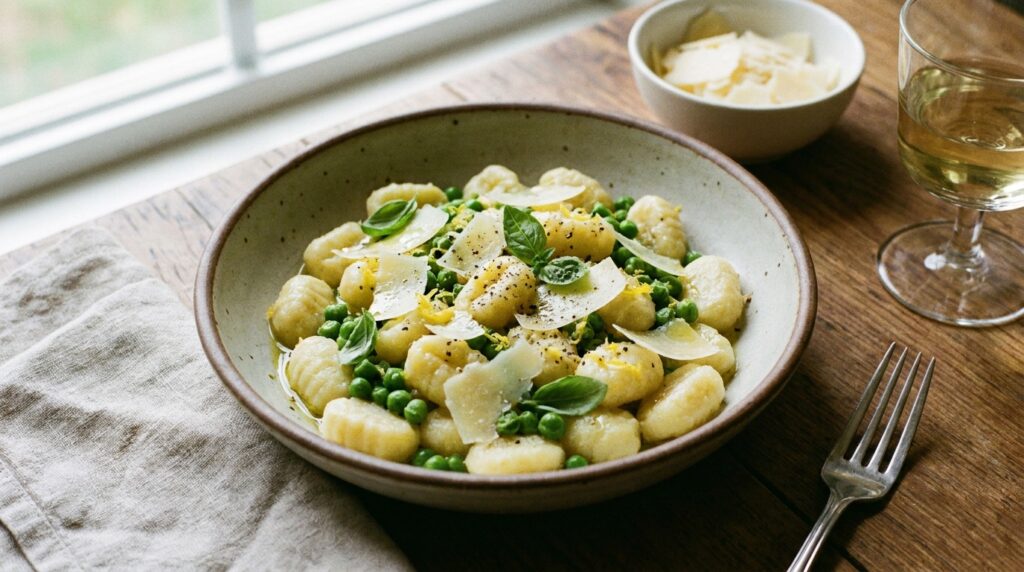
Gnocchi is deceptively simple to prepare, with results that consistently impress — and it’s an excellent way to make use of leftover baked potatoes. While gnocchi can be made with flour and egg alone, potato lends the finished dish a light, creamy, fluffy texture that is difficult to replicate otherwise.
Halve the potatoes and scoop out the flesh with a spoon. From here, the potato can be mashed by hand until light and fluffy, or passed through a ricer for an even finer, airier result. This step is most effective while the potatoes are still warm, as they pass through the ricer far more easily.
Season the riced potato with a spoonful of ricotta and a touch of salt and pepper, seasoning gradually to avoid a bland final result. Sift flour over the mixture to prevent lumps, then whisk in one egg. Form a well in the center and combine the mixture into a soft, pliable dough. Fresh thyme flowers can be added at this stage for a light, fragrant note that pairs beautifully with the ricotta.
Flour your hands generously before kneading the dough, folding and pressing gently until smooth. If the dough begins to feel wet, incorporate a small amount of additional flour, taking care not to overwork it — overworking prevents the gnocchi from puffing properly once cooked.
Once the dough reaches a soft, fragrant consistency, divide it in half and roll each portion on a lightly floured surface into a long rope, roughly the thickness of a cigar. The dough will remain slightly tacky; resist the urge to add excessive flour. Using a lightly floured knife to prevent sticking, cut the dough into bite-sized pieces, then press a floured fingertip into each one to create the classic pillow shape gnocchi is known for. Uniformity is not the goal — natural variation between pieces is part of the dish’s charm.
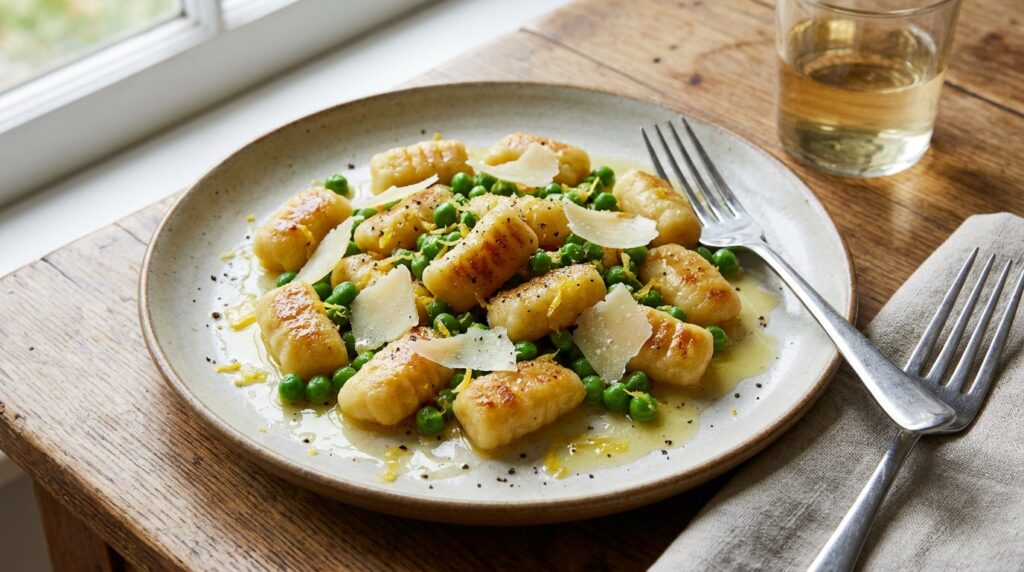
To cook, bring a pot of water to a boil with a touch of olive oil added. With lightly floured hands, lower the gnocchi into the boiling water and stir the pot gently to prevent sticking. The gnocchi are ready when they rise and float to the surface. While they can be served at this stage, blanching first and finishing in a hot pan produces a superior result.
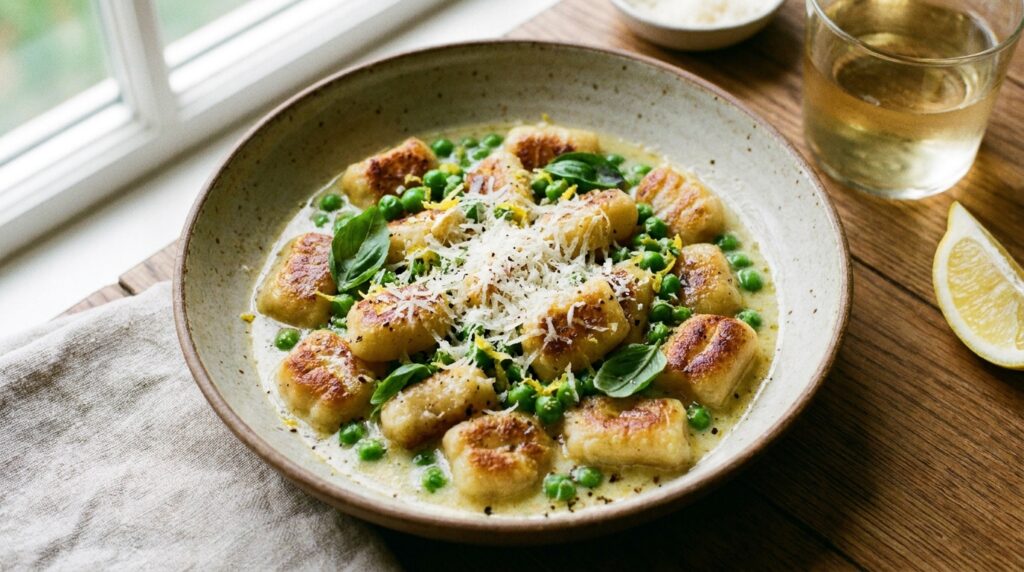
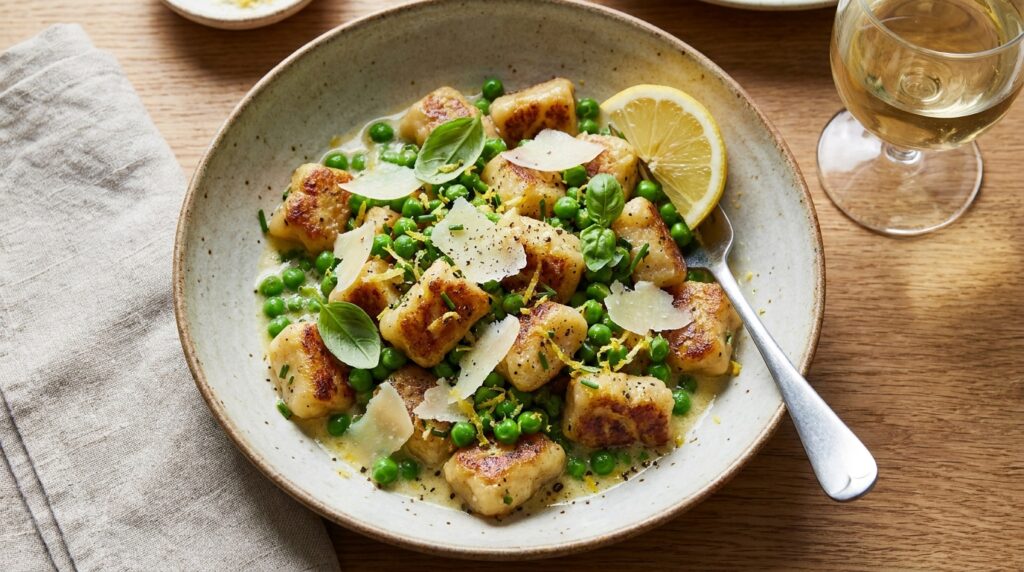
To finish, heat olive oil in a frying pan while lifting the risen gnocchi from the water, draining any excess liquid, and transferring them directly into the hot pan. This step transforms the texture entirely, developing a crisp, sautéed exterior while preserving a light, creamy center. Add freshly cracked pepper and fresh garden peas, along with a knob of butter for a rich, silky finish. Scatter fresh thyme over the peas, grate lemon zest directly over the pan, and finish with a generous serving of grated Parmesan.
A thoughtful approach to vegetables like this transforms a humble, budget-friendly dish into something genuinely elegant — inexpensive to prepare, straightforward to cook, and consistently impressive to serve.
Classic Baked New York-Style Cheesecake
When it comes to dessert, elaborate decoration is rarely necessary — simplicity is almost always more effective, and this cheesecake demonstrates exactly why.
Allow the cream cheese to sit at room temperature for five to ten minutes before use, which makes it significantly easier to work with. This particular recipe follows the classic New York style: baked, with no base. Begin by creaming the softened cheese together with sugar, whisking thoroughly until the mixture becomes light and smooth.
Add the eggs gradually, incorporating them one at a time rather than all at once. This technique introduces air into the batter and helps prevent separation. Whisk in a couple of tablespoons of flour afterward to keep the mixture smooth and free of lumps.
For brightness, add lemon zest, and gently fold in fresh raspberries, taking care not to crush them. Grease a cake tin thoroughly with butter to ensure a clean release once baked, then pour in the batter. Tapping the tin gently on the counter helps the mixture settle evenly, allows the raspberries to distribute throughout, and eliminates any trapped air pockets that could otherwise leave holes in the finished cheesecake.
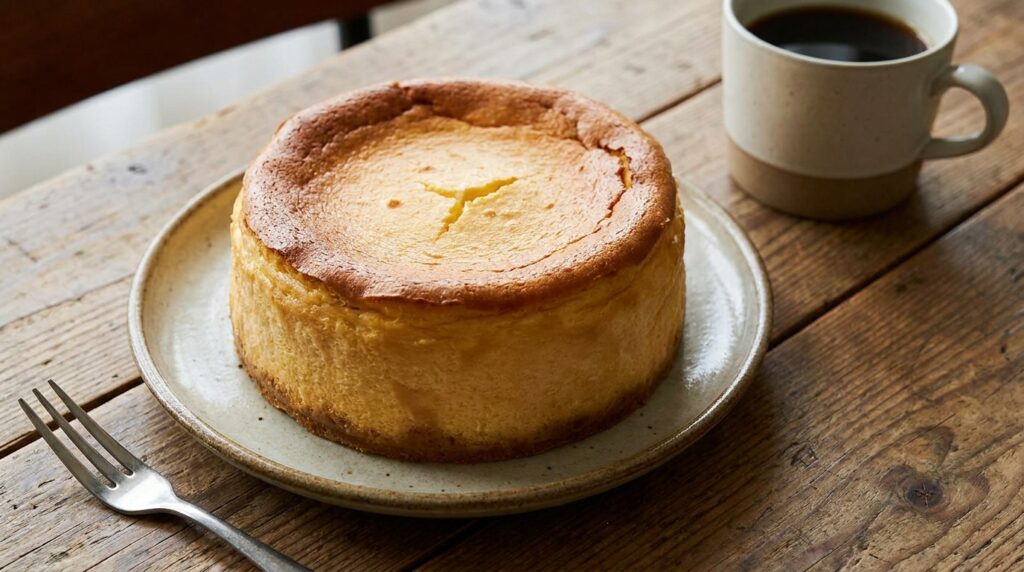
Bake at 180°C (350°F) for 35 to 40 minutes, until the cheesecake rises slightly and turns a deep golden color on top. The result is a dessert that is remarkably simple to make, yet strikingly elegant to serve.