
There’s a particular color wheel that has spent a bit too much time in the sun, and as damaged as it now looks, it turns out to be a surprisingly accurate depiction of exactly how hair color fades over time. Reds and oranges are the first to go. Every single orange, red, and copper shade that once lived in this hair has now faded into nothing but gold.
With an hour and a half free in the day, it seemed like the right time to tackle a full head of color.
The Starting Point
Ideally, the plan would be to use products already tried and tested in the past. But at the moment, there are no fewer than four different shades of blonde and golden, coppery color layered on top of one another. Looking at it through the lens of color theory and a very sun-faded color wheel, there’s really only one direction to go.
It’s worth bringing in a bit of festive comparison here: even though it’s the middle of June, a decorative tree left up well past its due date isn’t far off from what’s happening at the roots right now — both are overdue for a refresh.
Life has been especially busy lately with the launch of an annual wig sample sale — an event where every wig sample, prototype, test color, and design worked on over the past year gets opened up to the public. It’s always interesting to see how people respond, since these are technically not finished products; they’re half-finished pieces, not quite what was originally envisioned. Of the 17 units posted for this sale, nearly all of them sold within 24 hours.
Between the sample sale and everything else, personal hair maintenance took a back seat, resulting in a color situation that, as a hair specialist and wig designer, feels a little embarrassing to admit to. Earlier this year, a bold claim was made about returning to natural hair color, largely because of this exact scenario — there simply isn’t enough time anymore for the frequent touch-ups that used to happen as often as twice a month.
Understanding the Current Color
The natural hair color underneath everything is a specific shade — and layered on top of it are several variations: a copper version at the same depth (neither darker nor lighter, just more orange), what could be called peak orange with copper tones throughout, and a golden blonde that goes quite pale at the ends. That golden blonde has had its moment, and it’s time for it to go.
The real issue isn’t so much the patchiness, although that isn’t helping either — it’s that there’s no cohesive story left in the color. What was once an intentional look has grown out at the roots and faded everywhere else, leaving nothing consistent behind.
So the goal for the day is simple but practical: bring the hair to something neutral and socially acceptable, without veering into boring territory. The aim is to return to something natural-looking.
Weighing the Options
The first plan considered was using a color remover, applied strategically to just one chunk of dye to lift it closer to the surrounding shades, followed by an all-over color to unify everything. Two problems ruled this out: there was no color remover on hand, bleach wasn’t an appealing option, and more importantly, there wasn’t enough time for that process.
Instead, the second and preferred approach relies on color theory. The color wheel — battered by sun exposure as it is — actually demonstrates this well. Reds and oranges fade first. Purples shift into something rather unattractive. Blues, greens, and yellows, on the other hand, tend to cling to hair stubbornly, holding their color far longer than the warmer tones.
The natural base color here reads as a fairly true beige — not too warm, not too cool. If that natural shade were applied directly over the current copper tones, the result would land somewhere in the middle, mixing toward a more neutral zone. In other words: current color, plus ideal color, produces the applied result. Color theory in action.
This means introducing a degree of blue into the mix. Going full silver would be the most aggressive, traditional route toward pure neutrality, but a slight touch of warmth still feels appealing here, especially since the natural base already reads a bit icy. The decision lands on ash, with maybe a touch of ultra ash — just enough blue to cancel out the orange while keeping a subtle warmth intact.
One additional change: this application uses 20 volume developer, a departure from the usual preference for 10 volume.
Mixing the Formula
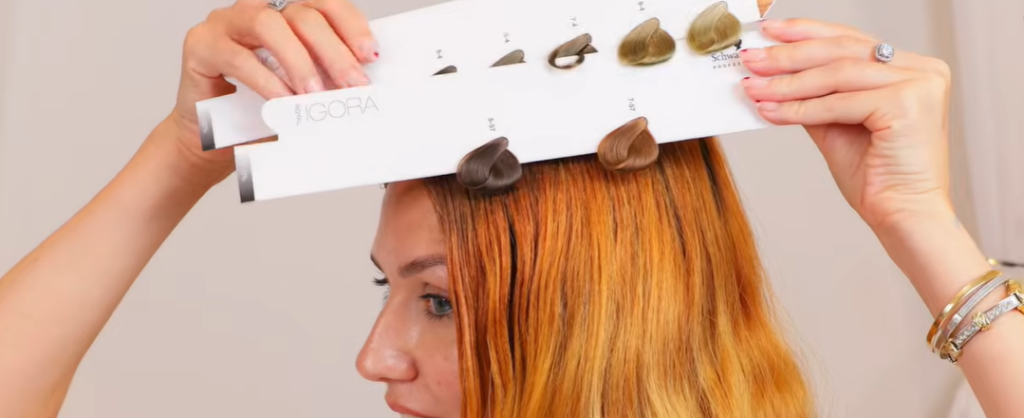
The starting shade is a 71 — essentially the exact depth of the natural hair color with just enough ash to begin canceling out the orange. This is done using the Schwarzkopf Igora range, a line that’s been second nature for years, though this same color-theory approach works with any brand of dye.
On its own, 71 isn’t quite potent enough as a blue corrector, so a 612 is added — a shade much closer to the desired value, shifting things further toward neutrality than 71 alone could manage. Since 612 by itself risks going too dark, a hint of 811 is blended in as well.
For the developer, equal parts of 10 volume and 20 volume are mixed together to create an effective 15 volume — offering enough lift to brighten the ends without risking over-processing the roots. The mix comes together as 40 grams of 20 volume and 40 grams of 10 volume, combined with 80 grams of dye total.
For anyone working with box dye rather than a professional line, the key is to look for words like ash, silver, or cool-toned on the packaging, since the numbering systems on box dye tend to differ significantly from professional salon products — names will be a far more reliable guide than numbers.
The Application Process
The process begins, as always, with a thorough brush-out. This particular hair went through an unusually long shedding phase over the winter, lasting well into April — longer than usual, and a bit alarming at the time, though it resolved on its own.
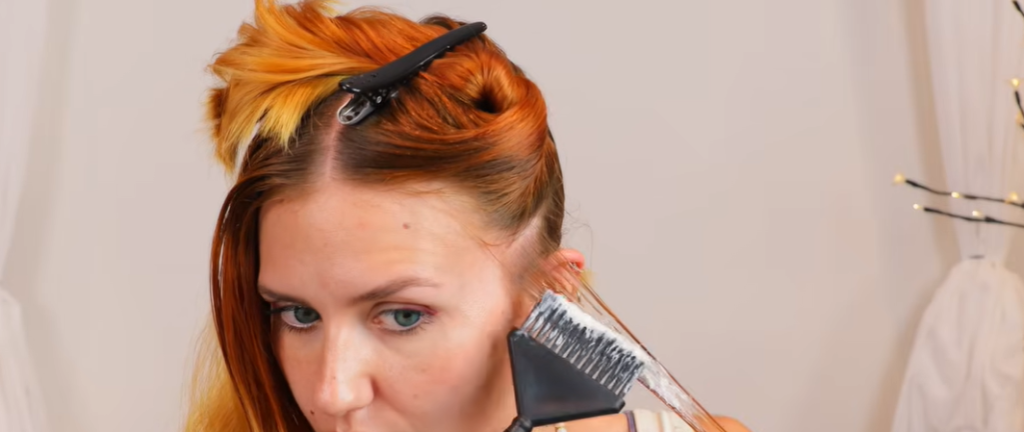
The hair is sectioned with the bottom half set aside separately, since a fairly significant haircut is planned alongside the color change, meaning a good portion of the ends will be cut away regardless.
With any color correction — and this situation certainly qualifies — good visibility is essential. Application should never happen on unclean, unsectioned hair, since seeing exactly where color needs to go is critical. The hair is divided into a first section, a second section, and the bottom section saved for last. Even pulling out a small section reveals just how many different slices and bands of color are actually present. It might be a bit of a placebo effect, but even mid-process, the hair already starts to look more blended and even — a genuine reflection of what color correction work actually looks like, not an exaggeration. This root touch-up was, frankly, about two weeks overdue.
Before full application, a K18 treatment — often forgotten despite having a surplus on hand — is set aside to apply to the ends later in the process.
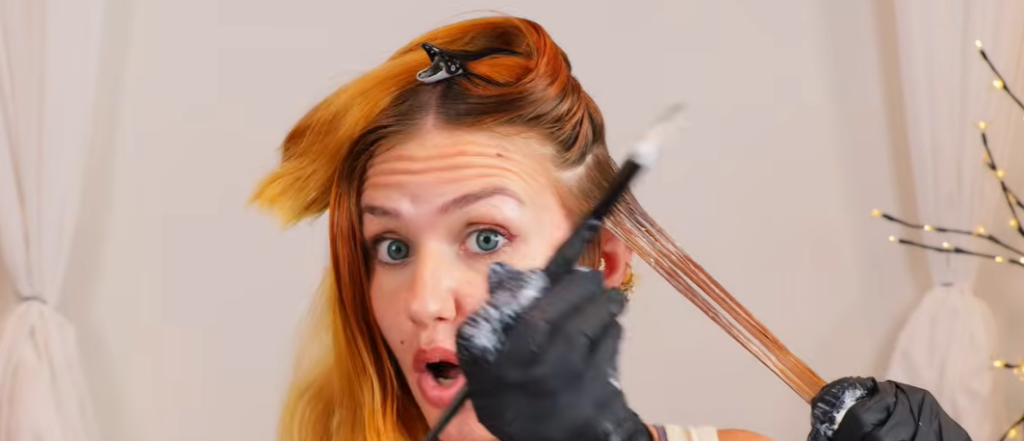
As the color goes on, the orange begins to disappear, which already feels like meaningful progress. Once the rest of the hair is colored all over, a lingering warmth is still visible underneath the blue, particularly noticeable when the hair is parted and examined more closely near the front, where the ash tone is pulling through most strongly.
The color is left to process for an additional 20 minutes after the initial application. By the time the back portion is finished, it’s still noticeably orange, but the plan is to let it develop, wash it out, and follow up with a color intended to even out the overall result.
One unplanned mishap along the way: dye dripped down the back of the neck and landed on a delicate necklace, turning what were assumed to be pearls into simple beads — a good reminder to protect jewelry during any at-home color session.
The Results
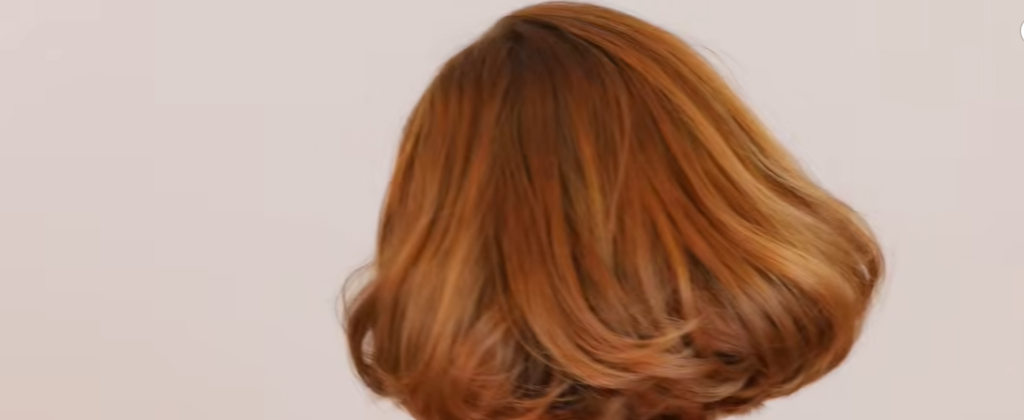
After 30 minutes and a wash, the color lands remarkably close to a natural shade. Some tonal variation is still visible near the bottom, which is a minor point of frustration, but overall this feels like a genuinely successful step in the transformation.
To finish things off, a haircut follows — partly because the ends had grown dry, and partly to complete the overall look. Initially, there was some hesitation about whether the haircut might be too dramatic a change to pair with the new color, but in the end, it feels essential to making the transformation feel complete.
The result is a natural color paired with a fresh cut, and the overall feeling is somewhat unexpected: a sense of recognizing an earlier version of oneself, but grown up. It’s been well over a decade since hair looked quite like this, and the outcome is more loved than anticipated.
Reflecting on the Change
This hair has long been associated with bright, bold, daring color choices, so returning to a natural shade feels like both the end of one era and the start of another. Years were spent in the past experimenting with nearly every color imaginable, and while there’s genuine excitement about revisiting bold colors again someday, there’s also real enthusiasm for seeing where this more natural chapter leads.
Highlights and bleached ends were briefly considered, but for now, the simplicity of the current look — seemingly untouched and effortless — feels like exactly the right choice. Change may well come again soon, but for the time being, this natural era is one worth enjoying fully.