
Introduction
Welcome back to Whiteboard Finance my name is Marco and I’m here to help you master your money and build your wealth. In this article we’re going to talk about the differences between term life insurance and whole life insurance.
Insurance is one of those things in life that’s pretty much necessary because well life happens. I could finish writing this article right now go for a bike ride and get hit by a car and that’s that Whiteboard Finance is over. Even though I’d like to think that my audience would create a Facebook memorial page and share my articles into eternity but we all know that probably wouldn’t happen.
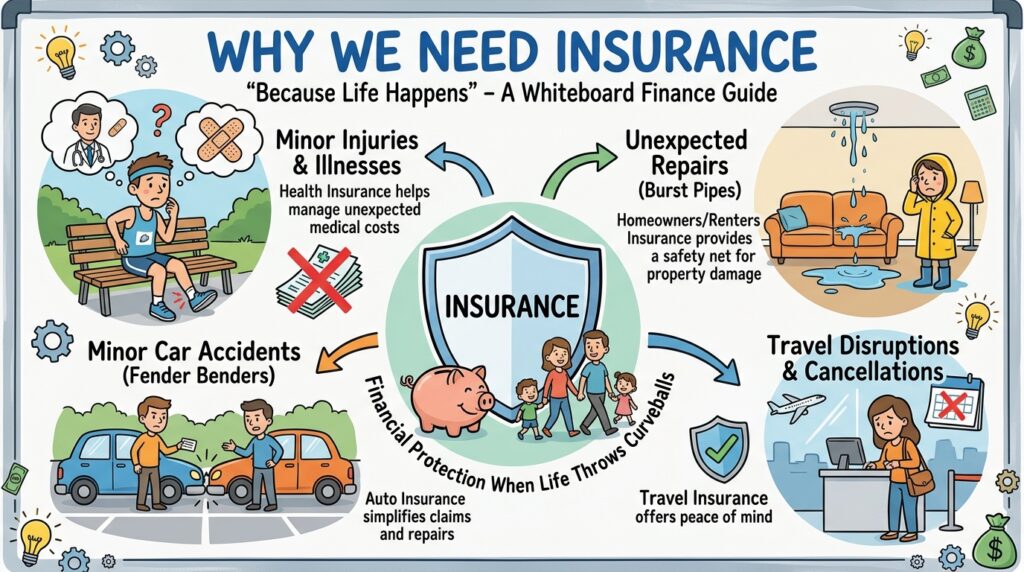
So the fact is that we’re all eventually going to need life insurance at one point or another all throughout our lives. In this article I’m going to go over the differences between term and whole life insurance.
Before I get into that however I’m actually excited to announce that I did decide to make this a sponsored article. Today’s sponsor is SimpliSafe. It’s an excellent home security system that’s completely wireless and the only reason I’m recommending it is because I use it myself. If I didn’t use it myself and know and trust it I would not make this a sponsored article.
SimpliSafe Home Security System
Everybody so I just wanted to introduce the SimpliSafe system. It is essentially an incredibly effective reliable home security system that will make sure your home is safe.
Basically your home is professionally monitored 24/7 so if anything happens they’ll make sure the police get called.
This thing is kind of like the brains of the operation. There’s a lot of really thoughtful features. You can see here that there’s a little sensor up here so if the glass gets shattered it automatically notifies the authorities and this thing starts ringing like an alarm.
There are also really cool features like these little sensors that go to the window so if this is lifted or separated while it’s being monitored that will also notify the alarm.

So essentially you’re covered. It’s really easy and intuitive to use. All you have to do is just put in your pin on the pad just like any other home security system.
The pricing is pretty fair and honest. It’s only 50 cents a day with no contract and you can cancel anytime.
The nice thing is that it’s equipped for worst case scenarios. In case you lose Wi-Fi or power this thing will still work. It’s equipped in case the system is attacked if you lose power or if you lose Wi-Fi.
The reason why I decided to go with SimpliSafe was because I read a lot of reviews and I know and trust it. This is essentially my business right here. This is my full-time income so I need to be able to protect this system at all times.
The nice thing about this system is that every single sensor that comes with this thing is very sleek and small so it’s not obtrusive.
Ultimately I just wanted to recommend a product that I like and use. Sponsorships come very rarely onto this channel so if I am recommending something I definitely use it and love it.
What Is Term Life Insurance?
Term life insurance provides coverage typically for a set period of time and most people go with 20 to 30 years on this. You can go less you can go more it all depends on what you want and what suits your needs.
If you or your spouse passes away during this time you are then paid the benefit of whatever the policy is. So if the policy is worth let’s call it $500,000 and you croak within these 20 to 30 years your beneficiaries — usually your spouse or your children or whoever you assign as the beneficiaries — will get this payout period.
The nice thing about term life insurance is that it’s very affordable. It’s actually much more affordable than whole life.
Typically this works out to be for every seven dollars in term life insurance for let’s call it a 20-year coverage period you’re probably going to be paying closer to a hundred dollars in whole life insurance for a 20-year period.
Term life insurance has no cash value. You’re not paying into any premiums and you’re not investing any money.
As mentioned before let’s use that $500,000 as an example. You pay a set amount per month let’s just call it 20 bucks for that. You get this amount of coverage whatever that coverage is and that’s it.
You’re not building anything you’re not investing that money and you’re not making any interest on that money. Think of it like car insurance. You’re just paying a set amount per month to get a certain amount of coverage.

This is actually not worth anything until you actually need it but that’s actually the whole point of insurance.
Pros of Term Life Insurance
Great for Income Replacement Upon Death
Term life insurance is a great choice for people that are looking to replace their income upon death.
If you’re someone who has a family of four and you’re making 50 grand a year you should typically have something that covers about 10 to 12 times your annual salary so in the event of your death your spouse or whoever your beneficiary is can take that lump sum invest in the market and hopefully live off the interest.
Pay Off Debt / Inexpensive to Own
The premiums are much lower than whole life insurance so you can actually use this to put down towards debt and pay off your debts and get out of debt.
Business Policies “Key Person” Insurance
If you have a key person that’s within an organization and they pass away the organization or whoever the beneficiary is will realize that insurance policy.
Cons of Term Life Insurance
Costly to Renew
This is one of the biggest cons. It’s costly to renew.

If you use the example of the 30 year old that gets a 30-year policy and he still needs it at 60 years old because maybe he’s still in debt or his finances aren’t in order and he still needs to work then it’s obviously going to be a lot more expensive than when he was 30.
When you’re 30 you have a lot more life to live you’re generally healthier and there are less health risks. When you get older obviously you have less time to live meaning the policy has a higher chance of being paid out which means the numbers have to work for the insurance company.
What Is Whole Life Insurance?
Whole life has three components that we need to talk about and this is what differentiates it from term.
1. Premiums
There are premiums obviously in term insurance but there has to be a reason why whole life is so much more expensive.
2. Death Benefit
This is just what it sounds like. This is the amount that you’re paid upon your death. Let’s just call it $500,000 for easy numbers.
3. Cash Value
This is the kicker. This is what differentiates whole versus term.
The cash value is pretty much what gets accumulated and what these sales people or insurance agents try and sell you on. It’s kind of like the savings component or investment component of a whole life cash value policy.
When you pay your premium the money that you pay obviously a big part of that is going towards actually funding the death benefit for the first five to ten years.
Very little is going towards your cash value in the beginning. The majority of these premiums are going towards the commissions of the person selling the policy.


They’re also going towards the administrative fees of actually running the policy and they’re also going towards funding the death benefit.
You’re led to believe that if you have a cash value whole life insurance policy you’re going to make 10 or 11 percent in the market and it’s going to grow and be tax deferred.
Actually that’s incorrect.
After all the fees and everything is said and done you’re typically averaging 1.5 percent to 2.2 percent on a whole life policy.
After you’ve paid into this death benefit for five to ten years that cash value starts to build more and more based off the premiums that you’re funding it with.
Beneficiaries and Cash Value
Beneficiaries are only entitled to the death benefit when you pass away.
When you pass away the cash value that you’ve built up this whole time goes away. It gets absorbed by the life insurance company.
This does not go to your beneficiaries.
If you have a $500,000 policy that goes to your beneficiaries but the cash value does not. That goes back to the insurance company.
That difference between the seven dollars and the hundred dollars you’ve been paying month after month after month does not go to your beneficiaries.
You also have no choice in how the life insurance company applies the premium.
You can’t choose what percentage goes to the cash value. It’s basically whatever their policy says and whatever those underwriters and analysts have decided.

The only way to get the cash value is to cancel the policy and surrender the policy. Then they’ll cut you a check for whatever that cash value is.
You’re losing your insurance just to get your own money back that grew at a very poor rate.
Pros of Whole Life Insurance
Coverage for Life
Whole life insurance gives you coverage for life. It’s not set to 20 or 30 years like term insurance.
Cash Value Is Non-Taxable
The cash value portion is non-taxable as long as it doesn’t exceed the total premiums that you paid.
You can also borrow against that cash value if you want to.
Borrowing against your cash value policy is like going to a payday lender of the middle class.
If your cash value policy is worth $50,000 and you borrow against it you have to pay a percentage to borrow your own money.

You’ve saved and contributed that premium every month and now if you want to take out money against it you have to pay interest on your own money.
Cons of Whole Life Insurance
Very Expensive
Whole life insurance is extremely expensive.
Very Inflexible
You don’t get to choose where the premiums go.
Slow Cash Value Accumulation
The first five to ten years are mostly funding the death benefit and fees instead of your cash value.
Cash Value Is Surrendered
The cash value does not go to your family. It goes back to the insurance company.
Cost Comparison Example
Let’s say we have a 31 year old guy that has a $100 a month budget to spend on insurance.
He can get $125,000 in term life insurance for seven dollars a month or $125,000 in whole life insurance for one hundred dollars a month.

If you did a simple investment calculation and invested the $93 difference at 8 percent over 20 years you would end up with approximately $52,917.
If you invested at 1.5 percent which is what whole life policies typically return after fees commissions inflation and everything else you’re going to end up with approximately $25,983.
That’s basically around a $28,000 difference.
Final Thoughts
Life insurance is expensive and in my humble opinion it’s one of the worst financial products out there because it’s not doing what it’s supposed to do.
It’s not supposed to be an investment product. It’s supposed to be an insurance product.
You don’t go to your car insurance company and say hey I’ll pay you more premium if you get me back 1.5 percent over 20 30 40 50 years.
This article was just meant to give you the big open facts about the difference between whole life insurance and term life insurance.
There are obviously different policies, companies, coverage amounts, health conditions, and ages that need to be taken into consideration.
For the middle class term life insurance often makes much more sense.
If you got value out of this article share it with one friend and I hope this helped you better understand the difference between term life insurance and whole life insurance.